20 October 2026
A Cavity Between Two Back Teeth, Rebuilt With a Tooth-Coloured Filling: A CBD Belapur Case Study

Some cavities are easy to ignore because they sit where you never look. A patient came to La Pearl Dental Boutique in Sector 15, CBD Belapur, with a cavity in a back tooth, tucked in between two teeth. Dr. Shriya Verma rebuilt it with a tooth-coloured filling, and the aim was bigger than closing a hole. The goal was to give the tooth back its shape, its strength and its ability to chew comfortably. Here is how that visit went, step by step.
Why a back tooth cavity needs more than a quick fill
Your back teeth do the heavy work. Every meal, from roti to a plate of biryani, passes through them first.
That is why a filling in a molar or premolar has a different job from a small repair on a front tooth. It has to carry real chewing pressure, day after day, and it has to feel natural when you bite down. A filling that looks fine but sits slightly high, or leaves a gap beside its neighbour, will keep reminding you it is there.
This case was a good example. The cavity was not on the top of the tooth where you can see it. It sat on the side, between two teeth, which is one of the most common places for a back tooth cavity to start and one of the easiest to miss.
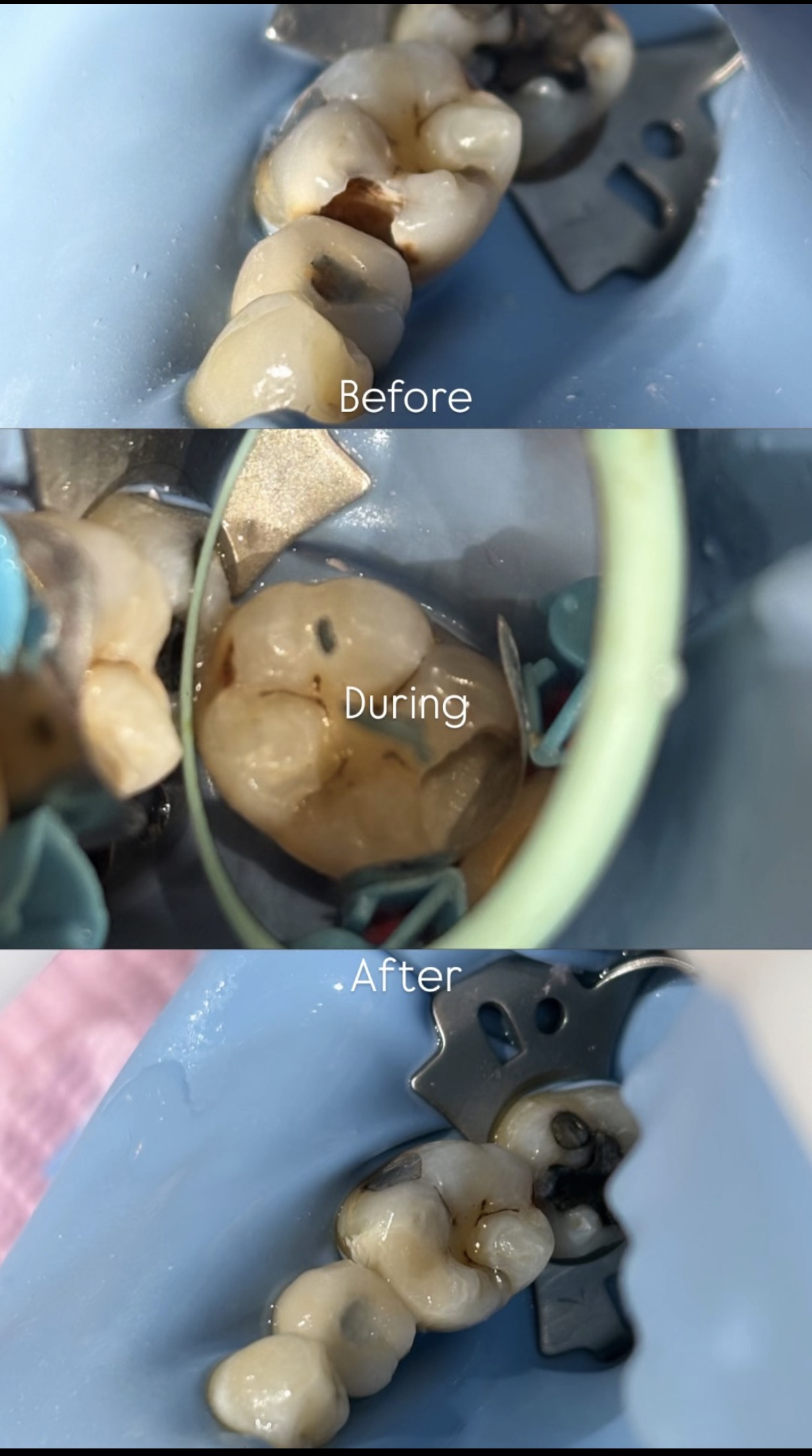
The exam comes first, then the decay comes out
Before any drill is switched on, the tooth gets a proper look. Dr. Shriya did a detailed examination to see how far the cavity had spread and what condition the rest of the tooth was in.
That step decides everything that follows. A cavity that is still in the outer layers of the tooth can usually be cleaned out and filled. One that has travelled deeper needs a different plan, and it is far better to know that before treatment starts than halfway through it.
Once the plan was clear, the decay was removed carefully. The aim is to take out all the softened, damaged part of the tooth and keep as much healthy tooth as possible. In the first photo above, you can see the dark, broken-down area on the side of the tooth that needed to come out. The tooth is also isolated from the rest of your mouth during this stage, which keeps the area clean and dry so the filling can bond properly.
Rebuilding the tooth with a tooth-coloured composite filling
With the decay gone, the tooth was rebuilt using tooth-coloured composite resin. This is a soft, putty-like material that bonds to the tooth and hardens under a special light.
Dr. Shriya did not place it in one lump. The filling was built up in layers, and each layer was shaped before the next went on. Layering lets the material set properly all the way through, and it gives the dentist control over the final shape of the tooth.
The shape matters more than most people realise. A back tooth has cusps, which are the small peaks, and grooves between them. Rebuilding those natural contours means the tooth bites against the opposite tooth the way it did before, and food glides off it instead of packing into it.
A tooth-coloured filling also blends in with the tooth around it, and because composite bonds to the tooth itself, it can be shaped to fit the space that is left.
Why a cavity between two teeth needs a proper contact
This is the part of a back tooth filling that patients rarely hear about, and it is the part that decides whether the filling feels good in daily life.
Because the cavity sat between two teeth, one side of the tooth had to be rebuilt right where it touches its neighbour. That touching point is called the contact. If it is too loose, food slips into the gap every time you eat, and you end up reaching for a toothpick after every meal. If it is too tight, floss shreds or will not pass at all.
To get it right, a thin band, called a matrix, is held around the tooth while the filling is built. It acts like a temporary wall, so the new material is shaped against it and ends up touching the neighbouring tooth snugly. You can see that band in the middle photo of the case.
Recreating a natural contact was a priority in this case, so that food would not get stuck between the two teeth.
Curing, polishing and checking the bite
Each layer of composite is hardened with a curing light. It takes only a few seconds per layer, and once it is done the material is solid and ready for shaping.
After the last layer, the filling was polished. A smooth surface feels better against your tongue, and it is also harder for plaque to cling to than a rough one.
Then came the bite check, which is the step that separates a filling that is merely finished from one that is comfortable. The patient was asked to bite down on thin marking paper, and any spot where the filling touched too hard was adjusted until the bite felt even. A high spot of even a fraction of a millimetre can leave a tooth sore for days, so this is not a step to skip.
The result: eating comfortably and smiling without thinking about it
By the end of the visit, the patient was happy to see their smile restored. They told our team they could eat comfortably again, and that they felt more confident smiling and speaking.
That feedback meant a lot to everyone at the clinic. It is easy to think of a back tooth filling as a small job, but a tooth that hurts, catches food or feels wrong changes how you eat and how you behave around other people.
At La Pearl Dental Boutique, the goal is that you stop thinking about the tooth altogether. Careful, personal attention to the small details is how that happens.
When a filling is not enough
A filling is the right answer when the cavity is caught while there is still plenty of healthy tooth to build on. It is not always the right answer, and it is better to say so clearly.
If decay has spread close to the nerve, the tooth may need a root canal first. If a large part of the tooth has broken away, a crown may protect it better than a filling can. Dr. Shriya will tell you which of these your tooth needs after the examination, and explain why.
The other direction matters too. Very early decay, where the enamel has only started to soften, is sometimes watched rather than drilled. The Cleveland Clinic notes that the earliest stage of a cavity can sometimes be reversed with fluoride, which is why an early check-up gives you more options. Our guide to cavities in baby teeth covers the same idea for children.
If your teeth need more than a single repair, the same careful approach runs through the smile design work at La Pearl, and our fractured front tooth case study shows how a front tooth rebuild is done.
Back Tooth Cavity Filling in Belapur: Your Questions Answered
How do I know if I have a cavity in a back tooth?
Often you do not, at first. Early cavities between teeth cause no pain, so the signs are easy to miss: food that keeps catching in the same spot, floss that shreds there, a dull ache when you chew, or sensitivity to cold and sweet things. A dental exam is the reliable way to find out.
Does getting a tooth-coloured filling hurt?
Most patients feel pressure rather than pain. Local anaesthesia is used when the tooth needs it, so the area is numb while the decay is removed. Some mild sensitivity for a day or two afterwards is common and usually settles on its own.
How long does a tooth-coloured filling last?
It depends on the size of the filling, how you bite and how well you look after the tooth. Brushing twice a day, cleaning between your teeth and avoiding chewing on very hard things all help. Your dentist will check it at your regular visits and tell you if it needs attention.
Why do cavities between two teeth need special care?
Because the filling has to recreate the point where the two teeth touch. A matrix band is used to shape that contact so food does not pack into the gap and floss can still pass through. Getting this right is what makes a filling in a back tooth comfortable to live with.
Can a cavity in a back tooth be fixed in one visit?
Often, yes. When the cavity has not reached the nerve, the decay can be removed and the tooth rebuilt in a single appointment, as in this case. Deeper decay can need extra treatment, and Dr. Shriya will explain that after the exam.
When can I eat after a filling?
Composite hardens under the light straight away, so you can usually eat once the numbness wears off. Avoid chewing on the side that was treated until you can feel your cheek and tongue properly again, so you do not bite yourself by accident.
If you suspect a cavity, do not wait for it to start hurting. Book a consultation with Dr. Shriya Verma at La Pearl Dental Boutique, Shop Number 4, Sai Vihar CHS, Sector 15, CBD Belapur, Navi Mumbai, Maharashtra 400614. The earlier a cavity is found, the more of your own tooth there is to save.